


Old Cut Diamonds
A Sparkling History of Diamonds Before They Learned to Behave
Old cut diamonds were made for candlelight, not ring lights.
They belong to a world before laser mapping, computer modelling, precision symmetry reports and anxious conversations about table percentages. They were shaped by hand, by eye and by tools that asked a great deal of patience from the person using them.
The story of diamond cutting is not simply the story of making diamonds sparkle more. It is the story of technology, taste, light, trade and fashion slowly learning what a diamond could do.
For centuries, diamonds were admired less for fire and brilliance than for rarity, hardness and mystery. A diamond was difficult to work, difficult to acquire and difficult to ignore. Early cutters did not begin by imposing elaborate designs on the stone. They began by polishing what nature had already made.
Over time, that changed. The point cut gave way to the table cut. The rose cut brought a soft, romantic shimmer. The Mazarin and Peruzzi cuts began the long journey towards the brilliant. Old mine cuts brought warmth and personality to Georgian and Victorian jewellery. Old European cuts refined the round diamond before modern proportions took over. Transitional cuts then carried diamonds into the twentieth century, halfway between antique charm and modern calculation.
Each cut tells us something about the age that made it.
The earliest cuts valued the crystal.
Later cuts valued light.
Modern cuts value performance.
Old cuts sit somewhere more atmospheric. They flicker rather than flash. They glow rather than glare. They are not always obedient, but that is rather the point.
Before Brilliance
The earliest diamonds used in European jewellery were not cut in the modern sense. For a long time, the diamond’s natural form was considered part of its appeal.
A natural diamond crystal often forms as an octahedron: two pyramids joined base to base. Early diamond workers polished the natural faces of the crystal to make them cleaner and more reflective. This was a cautious process, because diamond is extremely hard, and early tools could not easily reshape it.
At this stage, cutting was more negotiation than transformation. The cutter was not trying to force the diamond into a mathematically ideal design. He was trying to improve the stone without destroying its value, weight or structure.
This matters because old diamond cuts were often shaped by the rough crystal itself. Weight retention was important. So was durability. So was the way a stone looked in low light. A diamond seen by candlelight, torchlight or early gaslight behaved very differently from a diamond seen under modern shop lighting.
The result is a family of cuts that can appear irregular by modern standards, but which often have far more personality than perfection would allow.
The Point Cut
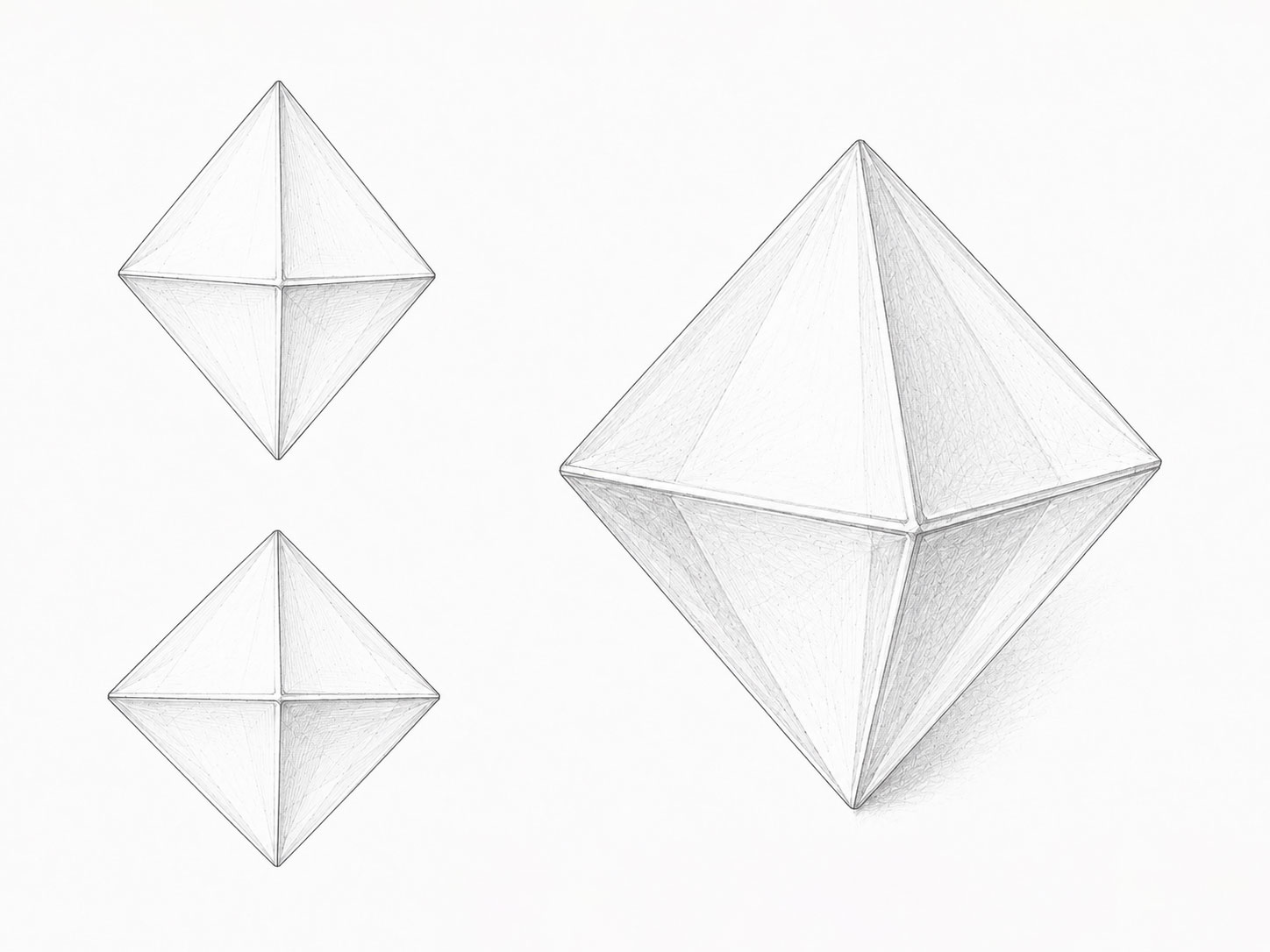
One of the earliest diamond forms, the point cut preserved the natural octahedral crystal shape, with polished faces meeting at a point above and below.
At a glance
- Facets: 8 polished natural faces
- Natural octahedral crystal shape
- No table
- No modern crown or pavilion
- Minimal cutting
- Low sparkle, soft glint
The point cut is one of the earliest known forms of diamond cutting in Europe and is usually dated to the mid-fourteenth century. It began to appear around the 1300s and was already established by the later fourteenth century. By the mid-fifteenth century, it was gradually being improved into the table cut, although older forms did not vanish overnight.
The point cut was not named after an inventor. Its name comes from its shape. The diamond retained the natural points of the octahedral crystal, with polished faces meeting in a point above and below.
In practice, a point-cut diamond was very close to the natural crystal. The cutter polished the eight natural faces of the octahedron rather than creating a complex new design. Little material was removed, which meant the stone kept almost all of its original weight.
This was one reason the cut made sense. In the medieval world, diamonds were rare, valuable and difficult to work. Removing large amounts of material would have been both technically challenging and financially alarming.
A point-cut diamond does not sparkle in the way modern readers expect. It has no pavilion designed to return light, no crown arranged for fire and no table to draw the eye into the stone. Instead, it glints. It catches light in small flashes and can sometimes appear dark or grey, especially in low light.
That did not make it unsuccessful. In its own period, the point cut represented refinement. It turned a natural diamond crystal into something deliberate, wearable and precious. Diamonds were admired for hardness, rarity and symbolic power as much as for optical brilliance.
The point cut was popular because it respected the diamond’s natural form, preserved weight and required comparatively limited intervention. It suited medieval and early Renaissance jewellery, where gemstones often carried religious, talismanic, dynastic or symbolic meaning.
Today, surviving point-cut diamonds are rare. When they do appear, they are more often encountered in museum collections, archaeological contexts or very early jewellery. For collectors, a point cut is not about sparkle. It is about origin. It is a diamond before diamonds learned to perform.
The Table Cut
coming soon
The table cut marked an important step in diamond cutting, flattening the upper point of the crystal to create a flat top facet, or “table.”
At a glance
- Facets: usually around 9-10, depending on form
- Flat top facet, or “table”
- Square or rectangular outline
- Based on the natural crystal shape
- Simple geometric form
- Early step towards designed brilliance
The table cut developed from the point cut and became important from the late fifteenth century onwards. It is generally associated with the Renaissance period, with documented references appearing by the 1490s. It remained in use through the sixteenth century and into the seventeenth, before more complex faceted cuts gradually replaced it.
The name is simple: the table cut is named for the flat table facet created on the top of the stone.
To make a table cut, the cutter ground or polished away the top point of the octahedral crystal. This created a flat upper surface. The lower point could also be modified, creating a culet. The result was a diamond that still retained much of the original crystal structure but had a more recognisable “jewel” face.
This was an important step. A table gave the diamond a window. More light could enter the stone, and the gem appeared more open and deliberate. It was still not brilliant in the modern sense, but it was a significant advance from the point cut.
The invention of the table cut is sometimes linked in popular accounts to Lodewyk van Bercken of Bruges, who is traditionally credited with improvements in diamond polishing and the use of the scaif. As with many early cutting histories, the exact documentary trail is cautious rather than theatrical. Van Bercken is an important figure in the history of diamond polishing, but it is safer to say that the table cut emerged through late medieval and Renaissance developments in cutting technology, rather than placing the whole invention neatly into one pair of hands.
The table cut became popular because it improved a diamond’s appearance while still preserving much of its weight. It created a flat surface that suited Renaissance taste for geometry, order and symbolic design. Table-cut diamonds appeared in rings, pendants, hat ornaments, devotional jewels and courtly jewellery.
The cut was also practical. Its flatter profile made it easier to set and less vulnerable than more projecting forms. In a period when jewellery was often heavy with symbolism, the table cut offered clarity and structure. It looked controlled, architectural and expensive.
By the seventeenth century, however, tastes and techniques had begun to move towards more faceted stones. Cutters increasingly wanted more light, more fire and more visual movement. The table cut did not disappear immediately, but it began to look simple beside newer cuts with greater optical ambition.
For collectors today, table-cut diamonds are especially interesting because they sit at the turning point between natural crystal and designed gem. They still belong to the world of the diamond as object, but they point towards the diamond as optical performance.
The Rose Cut
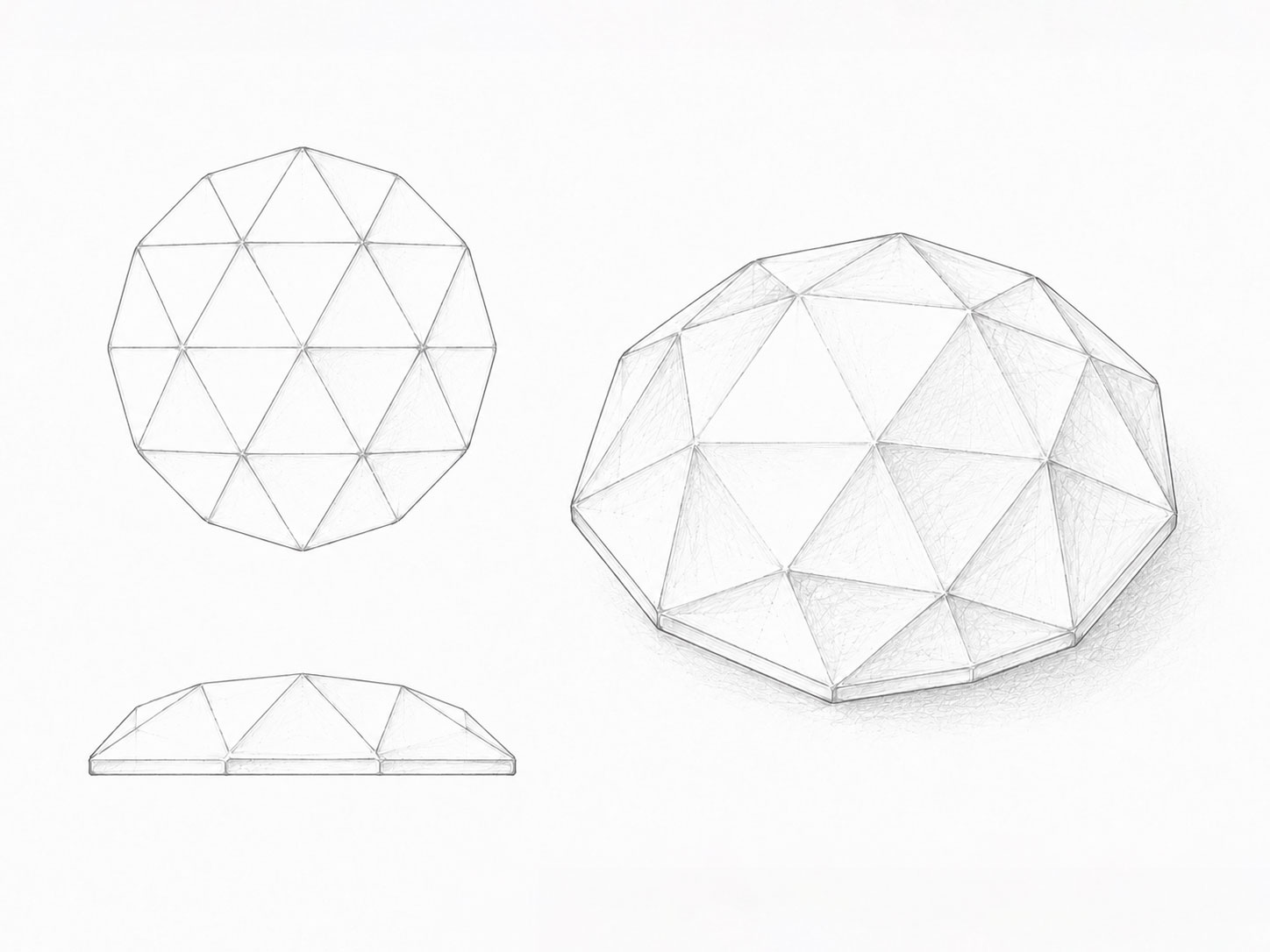
Flat-backed and domed, the rose cut was designed for soft shimmer rather than modern brilliance, making it especially effective in candlelight.
At a glance
- Facets: often 6-24
- Flat base
- Domed crown
- Triangular facets
- No pavilion
- Soft shimmer rather than sharp sparkle
The rose cut is one of the most enduring and romantic historic diamond cuts. It originated in the sixteenth century, with Antwerp and the Low Countries often associated with its early development. It remained popular for a remarkably long period, from the sixteenth century through the Georgian and Victorian eras, and continued to appear in jewellery into the nineteenth century.
The cut’s name comes from its appearance. A rose-cut diamond has a flat base and a domed crown covered with triangular facets that resemble the petals of a rosebud.
Unlike a modern brilliant, a rose cut has no pavilion. There are no lower facets designed to bounce light back through the crown. Instead, the stone lies flat underneath and rises above the setting in a faceted dome. The number of facets can vary, but rose cuts often have between six and twenty-four triangular facets, depending on the size, quality and style of the stone.
This gives the rose cut a very different personality. It does not return light in sharp, organised flashes. It glows. It shimmers. It has a soft, silvery radiance that can be extremely beautiful in candlelight.
The rose cut was popular because it suited the lighting conditions of its age. In candlelit interiors, the broad triangular facets could catch and release light gently across the surface of the stone. A rose-cut diamond does not need to dazzle aggressively to be effective. Its beauty is more atmospheric.
It was also efficient. Because it has a flat base and a domed top, the rose cut could preserve weight and make use of shallow pieces of rough. It was particularly useful for smaller stones and for settings where many diamonds were used together.
Rose cuts became especially associated with Georgian and Victorian jewellery. They appear in rings, earrings, brooches, pendants, rivière necklaces, buckles, tiaras and mourning jewels. They were often set in closed-back settings, sometimes with foil behind them to enhance brightness. This is one reason antique rose-cut jewellery must be treated carefully today: moisture can damage foil-backed settings, and enthusiastic cleaning can do more harm than good.
The rose cut began to fall out of favour as brilliant-style cuts became more dominant, especially in the nineteenth century. As cutting technology improved and tastes shifted towards greater sparkle, rose cuts became less central to fine diamond jewellery.
They never vanished completely. Today, rose cuts are admired for exactly the qualities that once made them old-fashioned: softness, character, romance and restraint. They are especially loved in antique jewellery and in modern designs that want historical atmosphere rather than modern uniformity.
A rose-cut diamond is not trying to behave like a modern brilliant. It has no interest in that sort of discipline. Its beauty is quieter, older and much more mysterious.
The Mazarin Cut
At a glance
- Facets: traditionally 34
- Early brilliant-style cut
- Cushion-like outline
- More sparkle than earlier cuts
- Associated with Cardinal Mazarin
- Important step towards the brilliant cut
By the seventeenth century, diamond cutting had become more ambitious. The Mazarin cut belongs to this important moment, when cutters began moving towards the brilliant cut.
The Mazarin cut appeared in the mid-seventeenth century, around the 1650s and 1660s. It was popular for a relatively short period before being overtaken by more complex brilliant-style cuts, especially the Peruzzi cut later in the seventeenth century and into the eighteenth.
The cut is named after Cardinal Jules Mazarin, the powerful French statesman, collector and adviser to Louis XIV. Mazarin was a great collector of diamonds and helped promote the taste for fine cut diamonds at the French court. However, it is important to be careful here: he is traditionally associated with the cut, but he probably did not personally invent it. The name seems to have been attached to him as a tribute and because of his influence as a collector and patron.
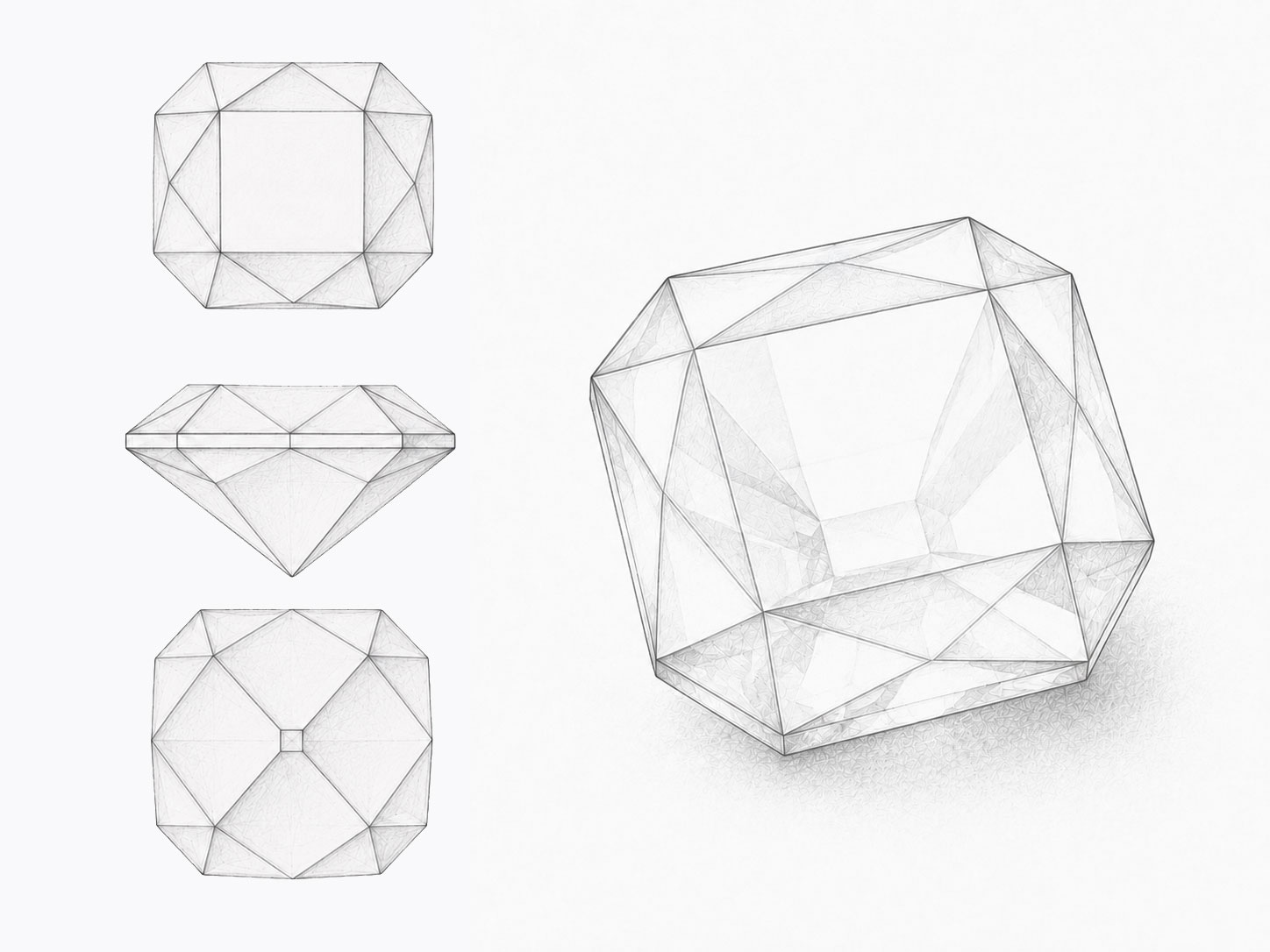
The Mazarin cut is usually described as a cushion-shaped brilliant-style cut with thirty-four facets in total: seventeen on the crown and seventeen on the pavilion, including the culet. This was a significant increase compared with earlier cuts.
The additional facets improved the diamond’s ability to reflect light. It showed more fire and brilliance than a point, table or simple rose cut. The diamond was no longer merely polished or gently shaped. It was being deliberately engineered for optical effect.
This is why the Mazarin cut matters. It represents one of the earliest serious attempts to create a brilliant diamond.
The cut became popular because it suited the growing splendour of seventeenth-century court culture. Diamonds were becoming increasingly important in displays of power, wealth and rank. At the French court, jewellery was not simply adornment. It was politics with facets.
The Mazarin cut offered more brightness, more movement and more sophistication. It gave diamonds a livelier surface and made them more suitable for grand court jewels, formal dress and royal collections.
Its period of dominance was brief because diamond cutting continued to develop rapidly. Once cutters understood that more facets could produce more brilliance, the direction of travel was clear. The Mazarin cut was soon improved upon by cuts with even more complex facet arrangements.
For collectors, the Mazarin cut is important less because many examples survive in everyday jewellery and more because it marks a key historical transition. It is the diamond beginning to understand that sparkle could be designed.
The Peruzzi Cut
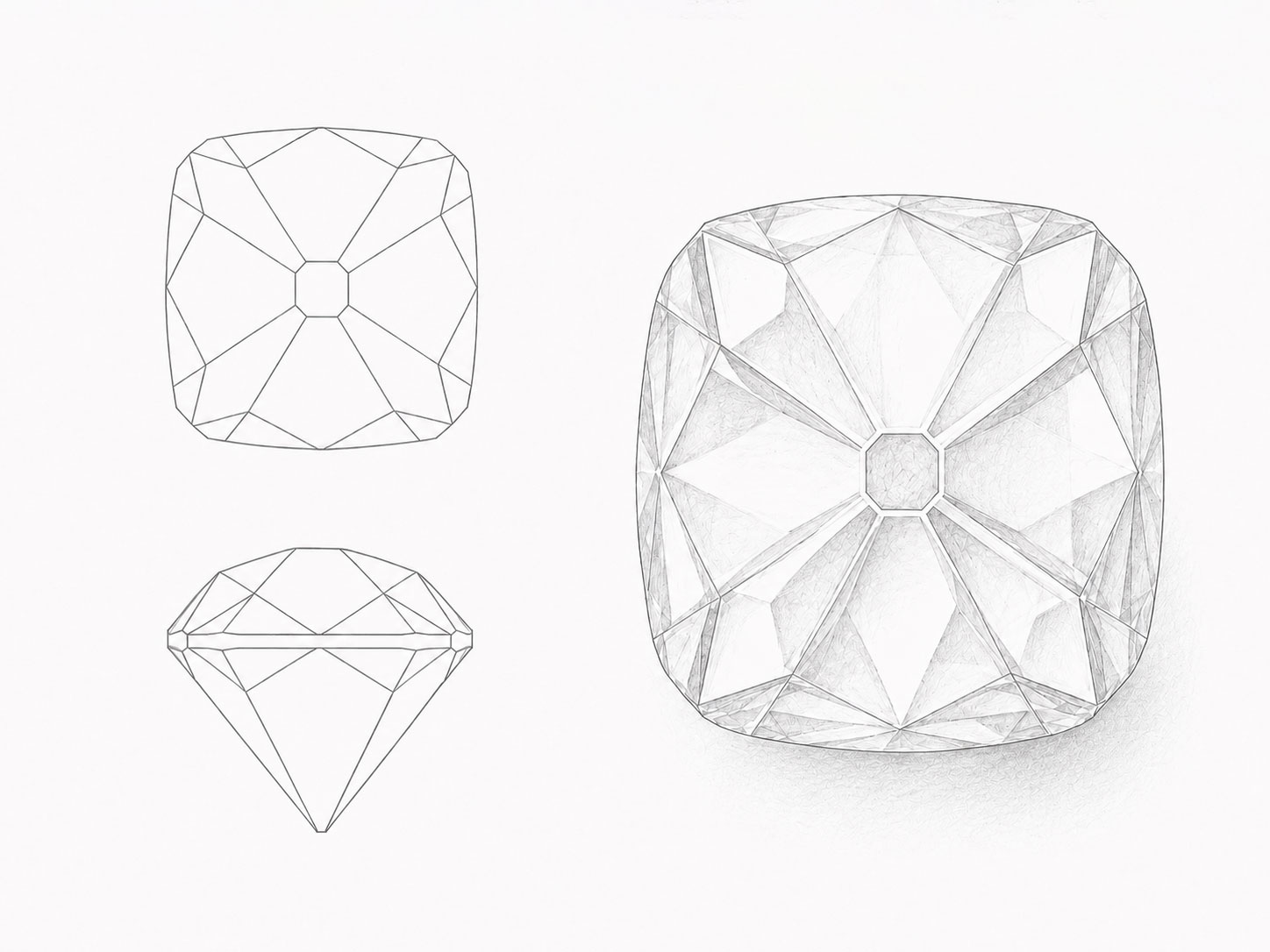
The Peruzzi cut introduced a more complex brilliant-style facet arrangement, helping move diamonds closer to the round brilliant forms that followed.
At a glance
- Facets: traditionally 58
- Later brilliant-style cut
- Cushion or rounded outline
- High crown
- Deep pavilion
- Often shows a cross-like pattern
The Peruzzi cut followed the Mazarin cut and represents another major step towards the modern brilliant.
It is usually associated with the late seventeenth century, around the 1680s, and is traditionally linked to Vincenzo Peruzzi, a Venetian diamond cutter. As with many early diamond-cutting attributions, the history is not always perfectly tidy. Peruzzi is the name traditionally attached to this development, but the cut should be understood within the wider progress of Venetian and European diamond cutting rather than treated as a single dramatic invention in isolation.
The Peruzzi cut is important because it increased the total number of facets to fifty-eight, including the table and culet. That number matters because it is the same general facet count associated with the modern round brilliant, although the proportions and appearance were very different.
A Peruzzi-cut diamond was usually deep, with a cushion or rounded outline rather than a perfectly modern circular form. The crown and pavilion could be relatively high, giving the stone a tall profile. Because these stones were cut by hand, no two examples were perfectly identical.
One distinctive feature often associated with the Peruzzi cut is a cross-like pattern visible through the table, sometimes described as a Maltese cross effect. This came from the arrangement of the facets and gives these stones a recognisable antique character.
The Peruzzi cut became popular because it created more brilliance than earlier cuts. It was an important step towards making diamonds lively in a way that suited eighteenth-century jewellery. More facets meant more opportunities for light to break, reflect and return to the eye.
This was still a world of candles and later oil lamps rather than electric lighting. The Peruzzi cut did not produce modern brilliance, but it offered greater sparkle and liveliness than earlier styles. It helped diamonds become more dynamic in jewellery.
The cut was used in high-status eighteenth-century jewels, including rings, pendants, cluster jewels and early formal diamond pieces. It suited the increasing taste for diamonds as major decorative stones rather than merely rare curiosities.
The Peruzzi cut began to fall out of common use as old mine cuts and later old European cuts developed. Yet its importance cannot be overstated. It helped establish the brilliant-cut idea: that a diamond could be designed around light, not just shape.
In the history of diamonds, the Peruzzi cut is a hinge. Before it, diamonds were becoming brighter. After it, brilliance became the goal.
The Old Mine Cut
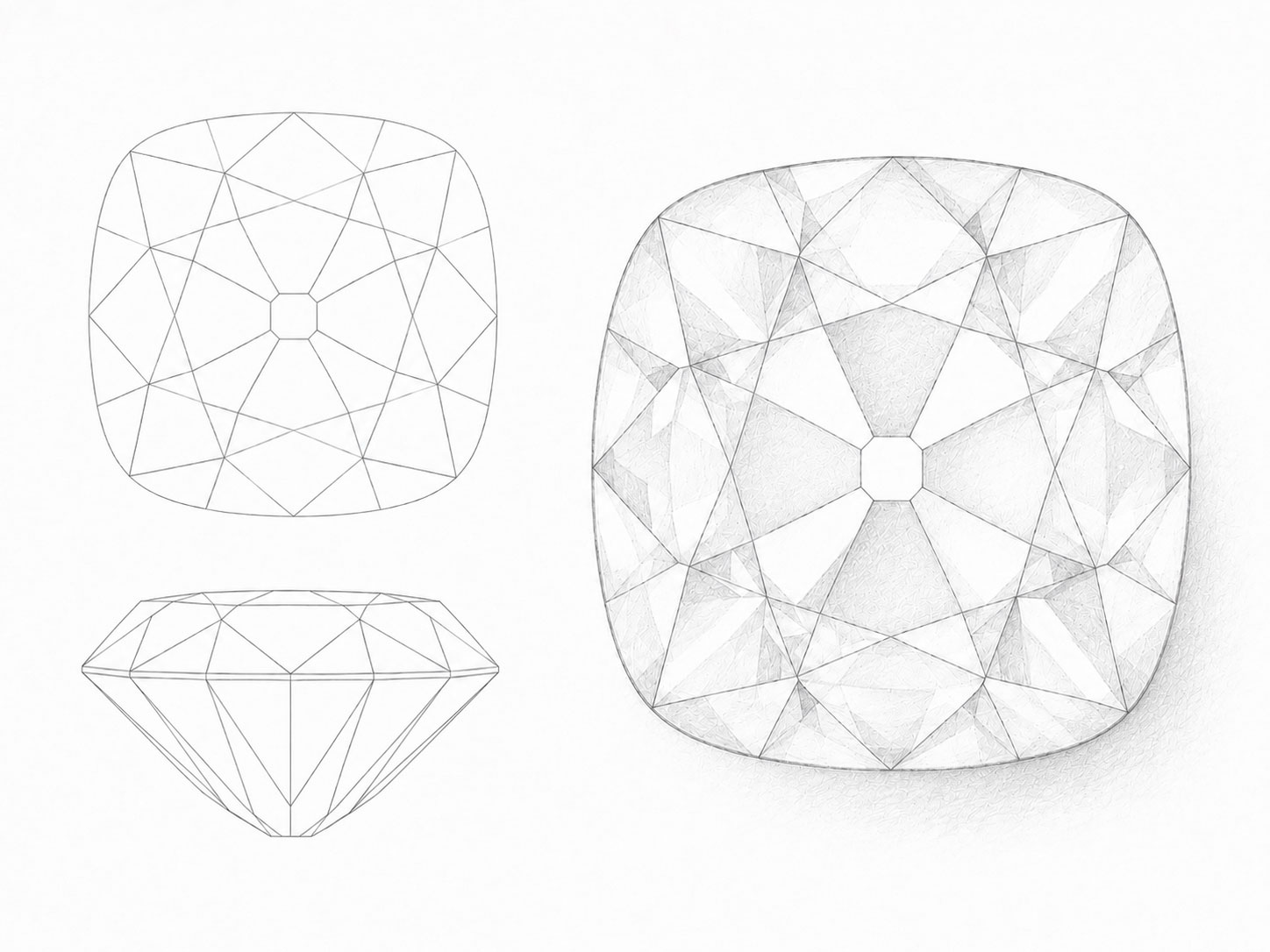
Usually cushion-shaped with a high crown, small table, deep pavilion and open culet, the old mine cut is one of the great character cuts of Georgian and Victorian jewellery.
At a glance
- Facets: usually 58
- Cushion-shaped outline
- High crown
- Small table
- Deep pavilion
- Large open culet
- Broad, chunky flashes of light
The old mine cut is one of the great character cuts of antique jewellery.
It developed in the eighteenth century and was widely used from the early 1700s through the nineteenth century. It remained common until around 1900, when old European and later transitional cuts began to take over. Old mine cuts are especially associated with Georgian and Victorian jewellery.
The name “old mine cut” does not refer to one inventor. It refers partly to the older sources of diamond material. The phrase is often linked to diamonds from the “old mines” of India and Brazil, before the major South African diamond discoveries transformed the market in the later nineteenth century.
The old mine cut is usually cushion-shaped, with rounded corners, a high crown, small table, deep pavilion and a large open culet. It generally has fifty-eight facets, like a modern round brilliant, but the proportions are very different. The outline is often soft, slightly irregular and pillowy rather than perfectly round.
These stones were cut by hand, usually to follow the shape of the rough diamond and preserve as much weight as possible. This is why old mine cuts vary so much. Some are nearly square. Some are elongated. Some are plump and deep. Some are charmingly uneven.
Modern grading often wants consistency. Old mine cuts prefer personality.
The cut became popular because it worked beautifully in the jewellery and lighting conditions of the Georgian and Victorian periods. Its high crown and chunky facets produced broad flashes of light. In candlelight and gaslight, this could be extraordinarily effective. Rather than the fast, sharp scintillation of a modern brilliant, an old mine cut gives slower, warmer flashes.
The old mine cut also suited the settings of its time. It appears in Georgian rings, Victorian brooches, rivière necklaces, cluster rings, pendants, tiaras and sentimental jewels. Many were set in silver-topped gold or closed-back settings, where the metalwork and stone worked together to enhance the effect.
Old mine cuts began to fall out of fashion as cutting tools improved and tastes moved towards rounder, more symmetrical stones. The development of mechanical bruting made it easier to produce round outlines, and the old European cut gradually replaced the cushiony old mine style in fine jewellery.
For collectors today, old mine cuts are highly desirable because they carry so much visible history. Their open culets, small tables and irregular outlines make them immediately recognisable. They are often less “perfect” in modern terms, but far more atmospheric.
An old mine cut looks as though it has seen weddings, inheritances, candlelit rooms and at least one decision nobody wanted written down.
The Old European Cut
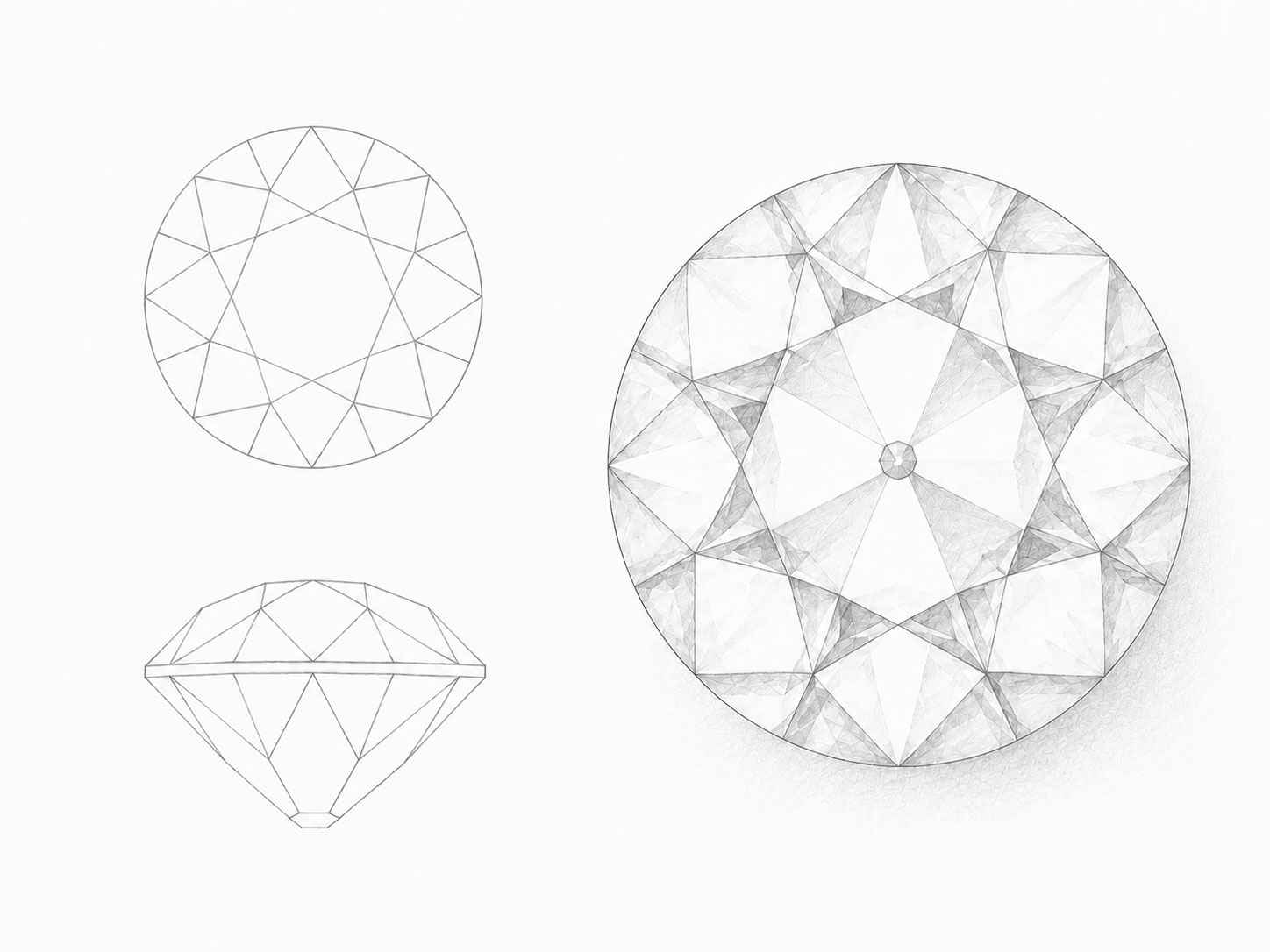
Rounder and more refined than the old mine cut, the old European cut has a high crown, small table, deep pavilion and open culet, giving it antique brilliance with unmistakable personality.
At a glance
- Facets: usually 58
- Round or near-round outline
- High crown
- Small table
- Deep pavilion
- Open culet
- More symmetrical than old mine cut
The old European cut developed in the late nineteenth century and remained popular into the early twentieth century, roughly from the 1890s to the 1930s. It represents a major step towards the modern round brilliant.
Unlike the old mine cut, which is usually cushion-shaped, the old European cut is round or nearly round. This became possible because cutting technology had improved. Mechanical bruting made it easier to shape diamonds into circular outlines, and cutters had a growing understanding of how proportions affected light.
The old European cut is not named after one inventor. The name is a later descriptive term used to identify this older round brilliant style. However, the development of more scientific diamond cutting in the nineteenth century is often linked with figures such as Henry Dutton Morse in Boston, who studied diamond refraction and helped move cutting away from pure weight retention towards improved optical performance. Charles M. Field, associated with Morse, is also linked with advances in mechanical bruting.
An old European cut typically has fifty-eight facets, a high crown, small table, deep pavilion and open culet, though usually a smaller culet than many old mine cuts. When viewed from above, the culet can appear as a small dark point or circle at the centre of the stone.
Compared with an old mine cut, an old European cut is usually more symmetrical, more circular and more refined. Compared with a modern brilliant, it is still deeper, warmer and less standardised.
The old European cut became popular because it offered a more modern style of brilliance while keeping the charm of hand cutting. It suited late Victorian, Edwardian and early Art Deco jewellery. Its round outline worked beautifully in engagement rings, pendants, earrings, brooches and delicate platinum settings.
This was also a period of changing light. Gaslight and electric light altered the way jewellery was seen. Diamonds no longer had to perform only in candlelit rooms. As interiors became brighter, the desire for diamonds with greater brilliance and more regular outlines increased.
The old European cut began to fall out of common use as twentieth-century cutting theory advanced. Marcel Tolkowsky’s 1919 work on diamond proportions helped shape the modern round brilliant ideal, and cutters increasingly moved towards stones with larger tables, smaller or closed culets and more standardised proportions.
For collectors, old European cuts remain one of the most loved antique diamond cuts. They offer a perfect balance between old-world charm and recognisable brilliance. They are bright enough for modern wear but still full of history.
They understand the modern room, but they have not entirely surrendered their manners.
The Transitional Cut
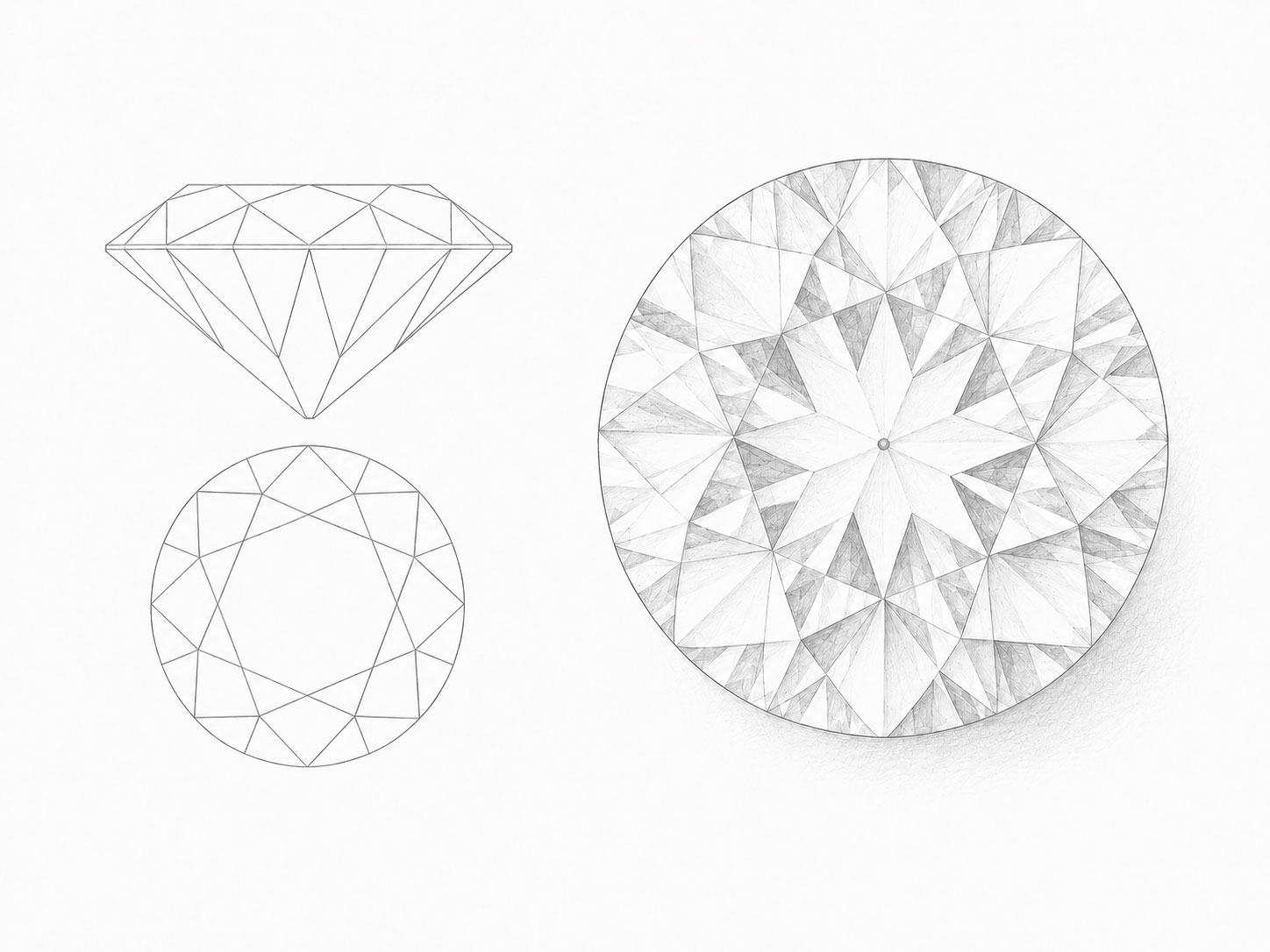
Sitting between the old European cut and the modern round brilliant, the transitional cut reflects early twentieth-century advances in diamond cutting and a move towards brighter, more standardised proportions.
At a glance
- Facets: usually 58
- Round outline
- Larger table
- Lower crown
- Small or nearly closed culet
- Brighter, more modern look
- Between old European and modern brilliant
The transitional cut belongs to the early twentieth century, especially the 1920s through the 1940s, with some examples extending into the early 1950s. It is not one single rigid cut, but a family of diamonds that sit between the old European cut and the modern round brilliant.
The name “transitional” explains the cut perfectly. These diamonds were made during the transition from antique hand-cut proportions to the more standardised modern brilliant.
There is no single inventor of the transitional cut. Instead, it developed as cutters responded to improved machinery, changing taste and the growing influence of scientific ideas about light performance. After Tolkowsky’s work on ideal diamond proportions in 1919, cutters increasingly adjusted older styles towards brighter, more efficient modern designs.
A transitional cut usually has a round outline, a larger table than an old European cut, a lower crown, shorter star facets and a much smaller culet. In many examples, the culet is tiny or closed. The overall effect is brighter and more modern, but often with a softness and individuality that fully modern brilliant cuts may lack.
These diamonds became popular because they suited the jewellery of the Art Deco and early mid-century periods. Cleaner geometry, platinum settings, sharper lines and brighter lighting all favoured diamonds with more regular brilliance. Transitional cuts worked well in engagement rings, geometric rings, earrings and Art Deco settings.
They began to fall out of common use once the modern round brilliant became standardised after the mid-twentieth century. Many transitional diamonds were later recut into modern brilliants, which makes good surviving examples especially interesting.
For collectors, transitional cuts have a particular charm because they sit between two worlds. They are not as obviously antique as old mine or old European cuts, but they are not quite modern either. They carry the last traces of hand-cut individuality while beginning to obey the new rules of optical performance.
They are diamonds learning modern manners, but not yet entirely convinced.
From Candlelight to Calculation
The evolution of diamond cutting is often described as progress, and in many technical ways it was. Cutters learned how to shape diamonds more accurately, how to use facets more effectively and how to maximise brilliance, fire and scintillation.
But progress is not the same as replacement.
Old cuts were made for different conditions, different tastes and different expectations. A point cut preserved the crystal. A table cut gave the diamond a face. A rose cut created candlelit shimmer. The Mazarin and Peruzzi cuts brought the diamond closer to brilliance. The old mine cut gave Georgian and Victorian jewellery warmth and depth. The old European cut refined the round diamond. The transitional cut carried the stone into the modern age.
Each cut was popular because it answered the needs of its time.
It preserved weight when rough diamonds were precious and scarce.
It suited the available tools.
It responded to the lighting of the period.
It fitted the jewellery styles people wanted to wear.
It reflected what people thought a diamond should be.
That is why old cut diamonds matter. They are not failed modern diamonds. They are successful historic diamonds.
Their proportions were not mistakes. Their culets were not accidents. Their uneven outlines were not necessarily flaws. They were the result of choices made in a different world.
Why Collectors Still Love Them
Collectors love old cut diamonds because they carry visible evidence of age and handwork.
A modern brilliant can be spectacular, but its beauty is often tied to precision. An old cut diamond offers a different pleasure. It asks to be looked at slowly. It changes with the light. It can appear quiet in one room and suddenly extraordinary in another.
Old cuts also help date jewellery. A rose cut in a closed-back setting suggests one kind of world. An old mine cut in a Georgian or Victorian mounting suggests another. An old European cut in an Edwardian platinum ring places the jewel in yet another moment. A transitional cut in an Art Deco setting tells us that the modern diamond was arriving, but had not yet fully taken command.
These cuts are also increasingly appreciated because many have been lost to recutting. Over the years, old mine, old European and transitional diamonds were often reshaped into modern brilliants to improve commercial appeal. That makes original old cuts more desirable today, especially when they remain in period settings.
There is also an emotional reason.
Old cuts feel human.
They show the hand, the eye and the limitations of their makers. They remind us that beauty does not always depend on symmetry, and that a diamond does not need to behave perfectly to be magnificent.
Old cut diamonds were never trying to be modern.
That is precisely why they still feel magical.